
Guide for teachers, officials and youth members
Digital product ideas for initiative contests on school violence, road safety, drugs and the environment
Digital product ideas for themed initiative contests: preventing school violence, road safety, drug prevention, environmental protection and youth communication; how to choose a problem, show impact and develop your own idea.
Quick summary
- A themed initiative convinces when it solves a specific problem in your own school or neighbourhood, not in general terms.
- Digital products such as QR reporting channels, scenario games, digital maps and chatbots make the initiative usable right away.
- For each theme, pick one main idea, trial it with real users and record the results.
- The idea belongs to the author: use the suggestions below as a starting point, not a sample to copy.
Themed initiative contests: how do digital products help?
Initiative contests on school order, preventing school violence, road safety, drug prevention or environmental protection share one thing: judges want to see a workable solution with real users and real change, not just a well-written essay.
A digital product takes an idea from paper into practice. A QR reporting channel, a scenario game, a digital map or a chatbot can be used straight away in a class, a school or a neighbourhood, and leaves figures that show impact. Below are suggestions by theme for you to choose, adapt and develop into your own initiative.
Choosing a theme and a specific problem
Start from what is happening
Where and when students get into fights; which stretch outside the school gate gets congested; which area collects litter. The more specific the problem, the clearer the solution.
Identify who benefits
Students, parents, teachers, residents or local young people. Each group needs a different approach.
Ask before you build
A short survey or chats with a few small groups show what people need and give you baseline figures for later comparison.
Pick something manageable
A solution that works within a few weeks in one class or school beats a big plan that cannot be carried out.
Combine real activities with the digital product
The digital product is a tool. It needs to go with real sessions, talks or campaigns to create change.
Initiative ideas for preventing school violence and keeping school order
Anonymous QR reporting channel
QR codes in classrooms and corridors lead to a short form where students report bullying or threats without giving their name. Set out clearly who receives reports and how quickly they are handled.
Chatbot for answers and finding help
Answers questions such as what to do about online bullying and whom to tell. The chatbot does not replace teachers; it helps students reach a trusted adult.
Interactive scenario game
Students choose how to react when teased, when they see a friend being hit or when pressured to join a fight, and see the outcome of each choice.
School safety map
A digital plan marking areas that need attention, the counselling room and staff on duty by hour, helping the school position supervisors well.
Short video series made by students
Each video shows one situation and one positive response, screened in class meetings and shared with parents by QR code.
Ideas for road safety initiative contests
Digital map of risk points around the school
Students and parents mark hard crossings, unlit stretches and parking that blocks the road, with photos and tips for travelling safely.
360° tour of the route to school
360° photos at difficult spots; tap to see how to look out and where to cross safely. Suits young students and class meetings.
Traffic scenario simulation
Players decide when to cross, whether to wear a helmet and how much distance to keep, and immediately see the result of each decision.
Quiz on road signs and rules
Short question sets by grade, played on phones, with a class leaderboard to build friendly competition.
QR guide to drop-off and pick-up
A QR code at the school gate leads to a parking plan, walkways and dismissal times by grade, easing rush-hour congestion.
Ideas for drug prevention initiative contests
“Know how to say no” role-play game
Scenarios of being offered e-cigarettes, drinks or unfamiliar sweets; players practise refusal lines and how to leave safely.
3D exhibition on disguised addictive substances
A virtual gallery with illustrations of common disguises, plus short narration on the harm and what to do if you come across them.
Discreet Q&A chatbot
Answers questions students are shy to ask in person, always with guidance to contact teachers, family or a support service when needed.
True-or-false quiz on rumours
Unpacks common misconceptions such as “trying once is fine”, helping students check and correct what they know.
Real-story videos
Short accounts from people with lived experience or prevention workers, shared with consent, not shocking and focused on a positive message.
Environmental protection initiative ideas
Digital map of litter and collection points
Residents and students report illegal dumping spots with photos; the map updates once a spot has been cleared.
Waste-sorting game
Drag each item into the right bin, with a short explanation after each turn. Works in class, in the schoolyard or at a fair.
3D exhibition of recycled products
Show recycled products made by students and youth members in a virtual room, each with its maker's name and method.
Green action log
Each class or youth branch records actions such as bringing a water bottle, planting trees or collecting old batteries; a summary shows weekly results.
Before-and-after 360° tour
Panoramic photos of an area before and after clean-up or planting, so everyone can see the change clearly.
Youth communication initiative contests: how to make it spread?
For communication initiatives, what is judged is whether the message reaches the right people and leads to action. A few approaches:
One message, many formats
The same idea turned into a short video, an image, a quiz and a QR notice board to suit each channel and audience.
Let young people create the content
Youth members and students film, write and host themselves; relatable content tends to be shared more.
Get viewers to take part
Challenges, quizzes and polls so viewers do something concrete instead of watching and scrolling past.
Link to real places
QR codes at the school gate, the community house or a bus stop lead to content relevant to that exact spot.
Measure views and participation
Record views, QR scans and plays for each round to see which channels work and adjust in time.
How to show the initiative's impact
Before-and-after figures
For example recorded fights, the share of students wearing helmets or the number of litter spots, measured the same way at two points in time.
Product usage figures
QR scans, plays, questions received by the chatbot, reports handled.
Knowledge surveys
A short quiz before and after the activity shows what students or residents have learned.
Real photos and feedback
Photos of sessions and comments from students, parents, teachers and residents about the changes they see.
Potential to scale
What other classes, schools or neighbourhoods need to follow; which parts of the product can be reused right away.
Things to keep in mind for themed initiatives
Develop your own idea
The suggestions here are only a starting point. Choose, combine and adapt them to your unit; do not copy someone else's sample entry.
Protect reporters and students
Anonymous channels should collect no unnecessary information; only a few responsible people should see reports.
Avoid shocking images
Especially for young students. A positive message that shows what to do usually works better than scaring people.
Check specialist information
Content on traffic rules, addictive substances or school psychology should be reviewed by someone with expertise before use.
Assign a long-term owner
Reporting channels, chatbots and maps need someone to update and respond; otherwise the product stops working right after the contest.
Frequently asked questions
What product should I make for a school violence prevention initiative contest?
You could start with an anonymous QR reporting channel, a behaviour scenario game or a short video series made by students. Choose the one that addresses the real problem in your school.
Is there a sample road safety initiative I can use?
This page does not provide samples to copy. An initiative is valuable when it comes from your own situation: survey the risk points around your school, use the suggested ideas and develop your own solution.
Where should a drug prevention initiative for students start?
From situations students are likely to face, such as being offered e-cigarettes or unfamiliar drinks. Practising refusal skills through scenario games usually works better than only talking about harm.
Does the digital product need to be complex?
No. A QR code to a form, a quiz set or a simple digital map that is actually used and has figures convinces more than a complex product nobody uses.
Can one initiative combine several themes?
Yes, for example a “Safe school” portal covering both road safety and violence prevention. Still, keep one main problem so judges can see the impact easily.
 Digital government
Sample product
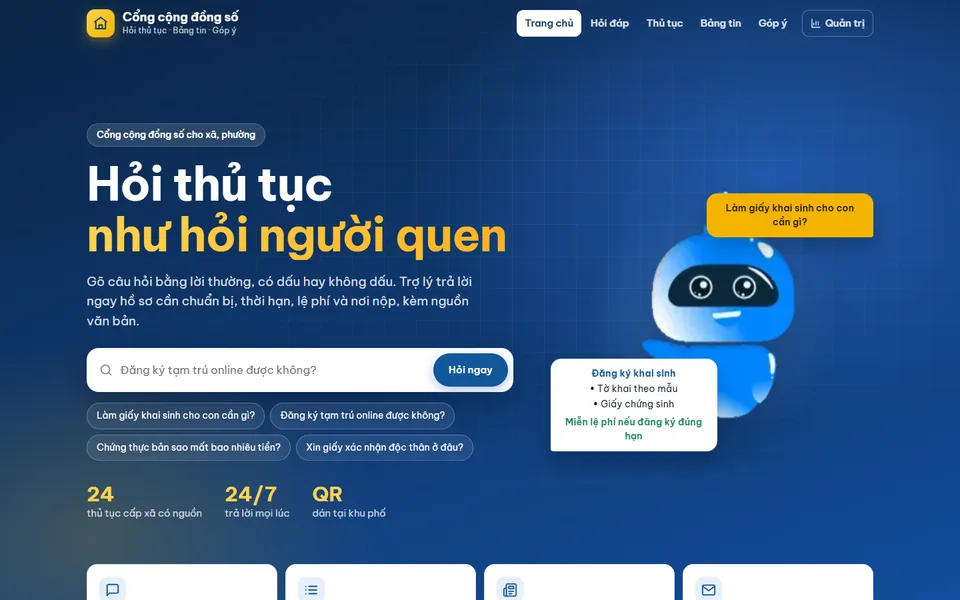
Digital community portal with a procedure assistant
Try a similar digital product live on a computer or phone. Real products are built around your own idea.
View demo (opens in a new tab)Need a digital product for your initiative?
We suggest ideas and work with you to build digital products: QR reporting channels, chatbots, scenario games, digital maps, 360° tours and 3D exhibitions, usually within 3–10 days.
Related articles
See all articlesMaking a digital entry
What a digitised contest entry means, which format suits STEM, AI, culture or initiative contests; how to prepare content, make the product work well on phones, submit it by link and QR code and present it to the judges.
ReadDigital transformation initiatives
Digital transformation initiative ideas for kindergartens, primary and secondary schools and communes; how to find ideas, trial them, present results and use a digital product to make the initiative more convincing.
ReadDigital youth projects
Ideas for digital transformation youth projects for schools, communes, wards and youth cells, and Pioneer projects for school-wide and class Pioneer units; how to choose an idea, steps from registration to handover, mobilizing resources and keeping the project alive after launch.
Read