
Guide for schools, neighborhoods and agencies
What does a Ho Chi Minh Cultural Space include? How to build it and its digital part
Which items make up a Ho Chi Minh Cultural Space, the steps to build one in schools, kindergartens, neighborhoods and agencies, how to take it online with QR codes, online bookshelves and 3D exhibitions, and how to present it convincingly.
Quick summary
- A Ho Chi Minh Cultural Space is a place to learn from and follow Ho Chi Minh, tied to the unit's daily activities.
- It usually has five groups: central idea, location, exhibits, materials and activities.
- A digital part such as QR codes, an online bookshelf or a 3D exhibition makes it livelier and reach further.
- What matters most is regular activity with real participation.
What is a Ho Chi Minh Cultural Space?
A Ho Chi Minh Cultural Space is a place, physical, digital or both, where officials, teachers, students and residents learn about President Ho Chi Minh's life, work, thought, ethics and style and follow them in daily work and study.
A good space is more than a nicely decorated corner. It is where things happen: reading, storytelling, themed sessions and displays of the unit's own good deeds.
What does a Ho Chi Minh Cultural Space include?
It can be split into five item groups, each with a physical part and, where useful, a digital part:
1. Central idea
A theme tied to the unit: learning for schools, community bonds for neighborhoods, public service for agencies.
2. Location
Accessible, dignified and safe; not necessarily a separate room. Units short of space can combine a small corner with a digital part.
3. Exhibits
Pictures and materials on Ho Chi Minh's life, work and teachings, plus the unit's own role models and activities.
4. Materials
Books and printed and digital materials: bookshelf, videos, audiobooks, QR codes to further reading.
5. Activities
Themed sessions, storytelling, quizzes, reading and displays of students' or residents' work, held regularly.
Steps to build a Ho Chi Minh Cultural Space
Step 1: Choose the central idea
One short sentence saying what the space aims for, tied to the unit's work.
Step 2: Choose location and format
A small corner, a separate room or online only; reuse existing space.
Step 3: Prepare content
Pick materials from official sources and cite them; add the unit's own stories and role models.
Step 4: Schedule activities
At least one activity a month linked to the space; assign someone in charge.
Step 5: Maintain and update
Add new content, check QR codes and links regularly; record participation.
Taking a Ho Chi Minh Cultural Space online
A digital part keeps the space open at all times, viewable on phones, reaching parents and residents and easy to update. Common formats:
QR codes
Placed at the corner, linking to stories, videos and materials. They should lead to real, updated content.
Online bookshelf and materials
Books, articles and videos about Ho Chi Minh to read on phones, plus the unit's own part.
3D exhibition, 360° tour
A virtual gallery viewable on phones, useful when space is short or to reach the community.
Audiobooks and storytelling
Stories about Ho Chi Minh recorded as audio and played by QR code, suitable for young children and older people.
Games and quizzes
Knowledge contests and crosswords about Ho Chi Minh make sessions livelier.
A dedicated page or section
One place to post activities and role models, with view statistics showing how the space is used.
How does it differ for schools, kindergartens, neighborhoods and agencies?
Kindergartens
Pictures, short stories and songs about Ho Chi Minh; a small class corner; QR codes so parents can listen to stories with their children.
Primary and secondary schools
Reading corner, student work, review games; tied to class meetings and youth activities; students help update it.
Neighborhoods and residential party cells
Tied to the community hall and notice board; local role models; QR codes on the board.
Agencies
No large space needed: a section on the intranet or portal, linked to staff following Ho Chi Minh's example.
Common mistakes
QR codes that don't open
Scanning opens an empty page, an expired link or a document that does not open on phones.
Unsourced materials
Pictures and quotes taken online without sources, possibly inaccurate.
Lots of decoration, few activities
Money spent on frames and boards without a regular activity schedule.
Built and left alone
No updates and nobody in charge of maintaining it.
Introducing and presenting a Ho Chi Minh Cultural Space
When showing the space to visitors, inspectors or judges, five short parts in 5–7 minutes work well:
Opening
Introduce the unit and the space's central idea in one sentence.
What the space includes
Walk through the main items and point out the digital part if any.
Regular activities
Number of sessions and participants, with one typical example.
Participants' work
Writing, drawings, videos and stories by students or residents.
Next steps
Content to add and how it will be maintained and shared.
Frequently asked questions
Does a Ho Chi Minh Cultural Space need its own website?
Not necessarily. Start with a section on an existing site, a fan page or QR codes. A dedicated page helps when the unit wants regular updates, a 3D exhibition and view statistics.
Is it expensive to build?
It need not be. Many items reuse what already exists; the digital part can start with QR codes and an online bookshelf and grow over time.
Where should materials about Ho Chi Minh come from?
Preferably official sources such as the National Political Publishing House Su That, the Ho Chi Minh Museum and heritage sites, cited when used.
How should a kindergarten build one?
Favor stories, songs and pictures children relate to; a small class corner; QR codes so parents can listen to stories with their children at home.
How often should it be updated?
At least one new activity or piece of content a month is a good rule, with QR codes and links checked each term.
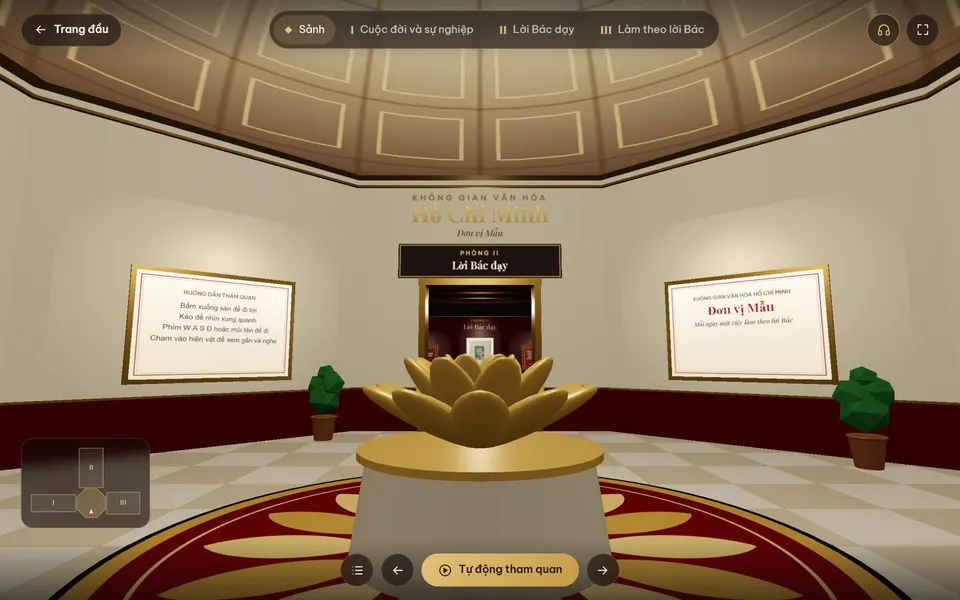 Digital exhibition
Sample product
Ho Chi Minh Cultural Space 3D/VR360 digital exhibition
Try a similar digital product live on a computer or phone. Real products are built around your own idea.
View demo (opens in a new tab)Need a digital Ho Chi Minh Cultural Space?
Your own portal, 3D exhibition, audiobooks, games and QR codes. You update the content yourself and get view statistics.
Related articles
See all articlesModels for following Uncle Ho
More than 15 model name ideas for schools, neighborhoods, agencies and youth unions; how to choose, name, run and record results, and ways to use digital technology to make models lively and widely shared.
ReadDigital heritage room
The role of a school heritage room, what it includes, steps to build it and collect materials, decoration ideas for primary and secondary schools, and how to bring it online with 3D, 360° and QR codes.
ReadVirtual museums in teaching
What virtual museums and exhibitions are, their types and benefits for teaching history, geography, literature, the arts and STEM; steps to make a 3D virtual museum, free tools, lesson ideas and how to let students create their own exhibitions.
Read