
Guide for cooperatives, household producers, small businesses and commune OCOP officers
How to write an OCOP product story: material, steps and common mistakes
A guide to writing an OCOP product story from a producer's real material: what the evaluation council looks at, gathering material, a short version for the label and a full one for the dossier, and putting the story on packaging, e-traceability pages, websites and online booths.
Quick summary
- In the current OCOP criteria, the product story is a separate item under marketing capacity, worth 12 of 100 points in the food product criteria.
- High scores come from an original, concise story told in a narrative voice, rooted in local identity, and presented on leaflets, a website and electronic traceability content.
- A story that copies another producer's, or is shared by several products of the same producer, loses the local identity points.
- Write three versions: one or two sentences for the label, a short paragraph for leaflets and websites, and a full version with photos and video as evidence in the dossier.
What an OCOP product story is and why it matters
A product story tells where a product came from, who makes it, how it is made and what local values it carries. It is not a list of specifications. Buyers remember a product because of the people behind it far more than the numbers on the label.
In the current OCOP criteria (Decision 26/2026/QĐ-TTg, applied from 22 May 2026), the product story is a separate item under marketing capacity. In the food product criteria it is worth 12 of 100 points, plus points for a label carrying the story's message in the product section. The story therefore helps sales and directly affects the star rating.
What the evaluation council looks at
Scoring of the product story revolves around three questions: where the story is presented, how well it is written, and whether it truly belongs to this product.
Where the story is presented
Points rise when the story is documented and printed on leaflets, then published on a website with photos and video, and are highest when it is part of the product's electronic traceability content.
Concise, in a narrative voice
The story is succinct and reads like a story with people and events, not an advertisement or a list of benefits.
Local know-how and identity
An original story tied to the product's origin, showing local traditions, culture and distinctive values; the top score goes to a story that is moving and convincing.
No duplication
A story identical to another producer's, or to another product's story from the same producer, earns no local identity points. Each product needs its own story.
A label carrying the story's message
In the product section, a label with the story's message earns points, and more when it also carries an electronic traceability code.
Gather material before writing
Good stories are written from real material. Before writing, sit with the people who make the product and note the following, as concretely as possible:
How the idea began
When and why the product started: a memory, a grandmother's recipe, a failed harvest, a customer's request.
People
Who keeps the craft, who found a new way of making it, who is in the family or cooperative group, how long they have worked at it.
Raw material area
The land, water, climate, plant varieties and breeds of the area; why raw material here differs from elsewhere.
Methods and know-how
Which steps are done by hand, which need experience, what the makers never skip.
Cultural value
Links to local festivals, customs, Tet dishes, legends or heritage sites.
Commitments and evidence
What the producer promises buyers, with photos, certificates and verifiable figures.
Steps to write the product story
Pick one highlight
Do not tell everything. Choose one distinctive detail, such as a special step or a craft keeper, and build the story around it.
Open with a person or a moment
Start with a person, a scene or a specific time instead of a generic line like “made from natural ingredients”.
Use real details
Real names, places, seasons, years and figures make a story more credible than any adjective.
Tie it to the homeland
Show readers that the product could only come from this land and these people.
End with a promise
Close with what the producer wants buyers to receive, written simply and true to what it can deliver.
Write three lengths
One or two sentences for the label and traceability code; a paragraph of about 150–300 words for leaflets, websites and e-commerce; a full version with photos and video for the dossier and fair booths.
Review with the makers
Ask the makers to read and correct it; check spelling and keep product and producer names consistent across all materials.
Common mistakes in OCOP stories
Formulaic and generic
Every line says “dedicated”, “quality”, “safe” and would still fit if the product name changed. Such stories are forgettable and unlikely to earn identity points.
Only listing specifications
Ingredients, weight and uses are product information, not a story.
Copied or shared stories
Copying another producer's story, or using one story for several of your products, costs points and credibility.
Unverifiable claims
Founding years, awards and origins must be true and backed by documents or photos when needed.
Inconsistent materials
Labels, leaflets and websites with different fonts, names or spelling mistakes weaken the story.
Putting the story on labels, traceability codes and leaflets
A story only works when buyers can read it. The short version belongs on the label; the long version on the traceability page buyers open from the QR code on the stamp.
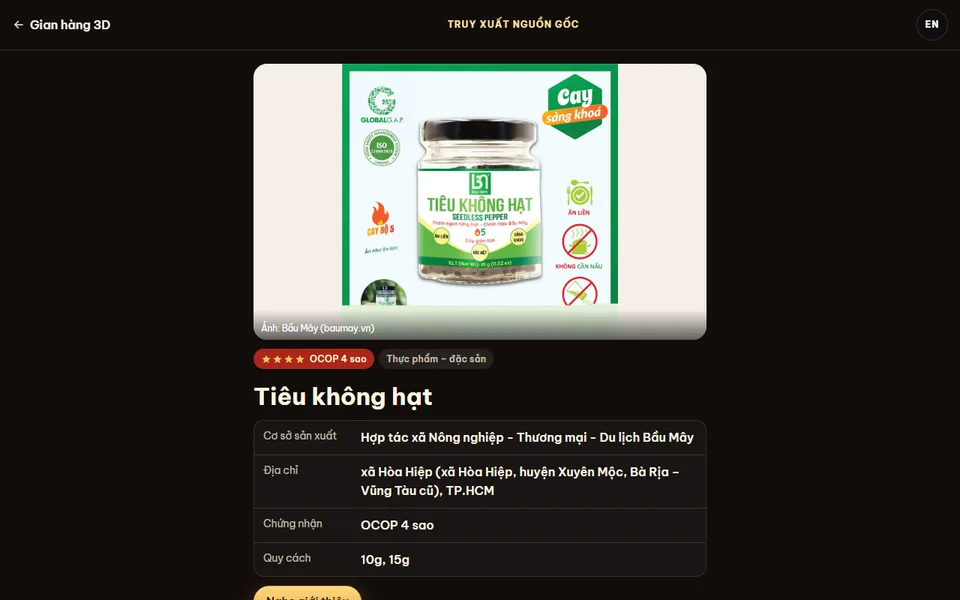
On the label
One or two sentences, enough for a buyer holding the product to know where it comes from.
Traceability page
Scan the stamp to see the producer, raw material area, certifications, story and photos, and hear a narrated introduction.
Leaflets and small catalogues
The medium version with photos of the makers and the raw material area, for fairs, shops and gifts.
Telling the story with images, video and digital spaces
Beyond words, a story is told better when viewers can see the orchards, the workshop and the makers:
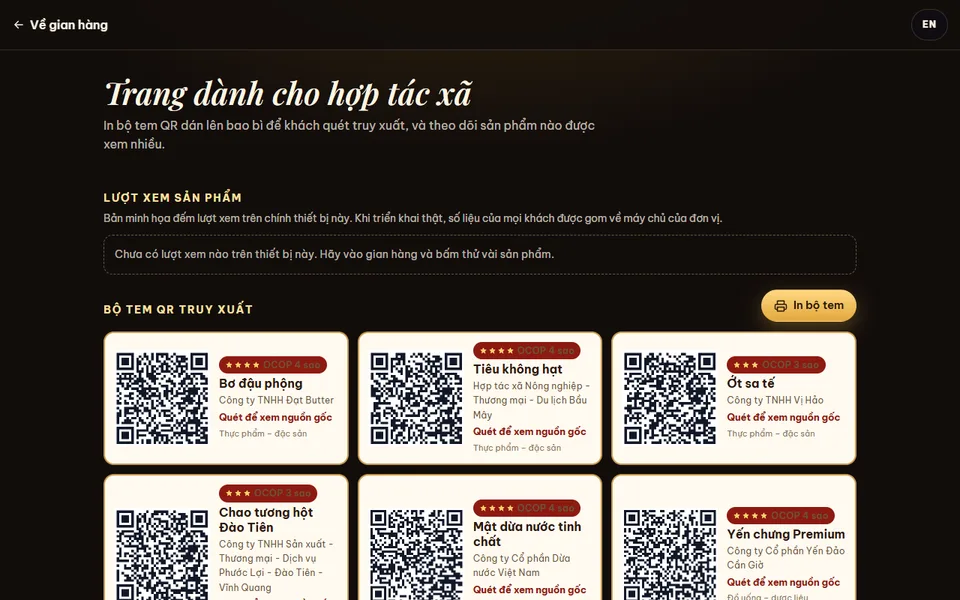
Website or product page
A page per product with the story, photos, a short video and where to buy; easy to share on Zalo and Facebook.
Short videos
One to two minutes on a production step or a craft keeper, for social media, livestreams and fair screens.
3D online booth
Products displayed in a 3D space; tap each one to read its story, hear narration and open its traceability page.
360° tour of the raw material area and workshop
Distant buyers can “visit” where the product is made, building trust in its origin.
Tracking views and scans
See which products draw interest and which stories are read most, then adjust how you present them.
The story in the OCOP evaluation dossier
The OCOP dossier has no separate form for the story. In the self-assessment report, the producer presents the product story and submits evidence such as copies of leaflets, photos, films and recordings, plus a section on the producer's history. Having leaflets, a website link, a traceability page and videos ready makes the dossier more complete.
Each province evaluates and ranks products at least twice a year, and certificates are valid for 36 months. A certificate nearing expiry is a good moment to rewrite the story to the new criteria.
Frequently asked questions
How many points is the OCOP product story worth?
Under Decision 26/2026/QĐ-TTg, the product story is a separate item under marketing capacity; in the food product criteria it is worth 12 of 100 points. A label carrying the story's message earns extra points in the product section. Other product groups may differ, so check the criteria for your group.
How long should an OCOP product story be?
No length is set. The criteria value concision. Prepare one or two sentences for the label, about 150–300 words for leaflets and websites, and a full version with photos and video for the dossier.
Can several products of one producer share a story?
It is not advisable. A story identical to another product's, even one of your own, earns no local identity points. The producer's history can be shared, but each product needs its own highlight.
Can someone else write the product story?
Yes. A writer can organize, edit and present it, but the material must be the producer's real story, and the makers should read and confirm it before printing and submitting the dossier.
Does the story need a QR traceability code?
The criteria use the term “electronic traceability”. Including the story in electronic traceability content, usually opened from a QR code on the stamp, is the top level for presenting the story; a label with a traceability code also scores higher.
Related demos
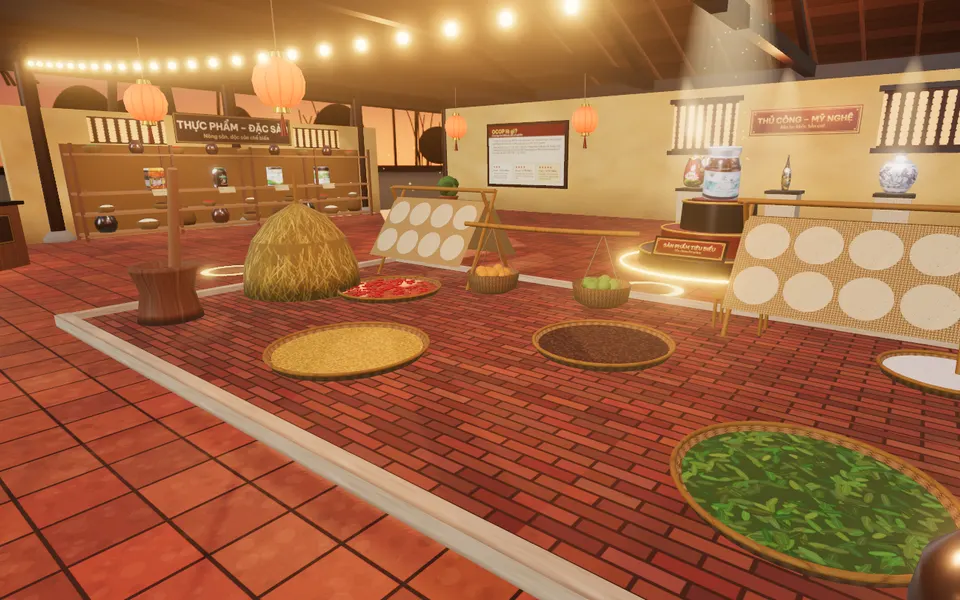 OCOP products
Sample product
3D OCOP product space
A 3D stall in a village market hall: OCOP products grouped into food specialties and handicrafts, with narration and a traceability page opened by QR code.
Try it live on a computer or phone. Real products are built around your own idea.
View demo (opens in a new tab)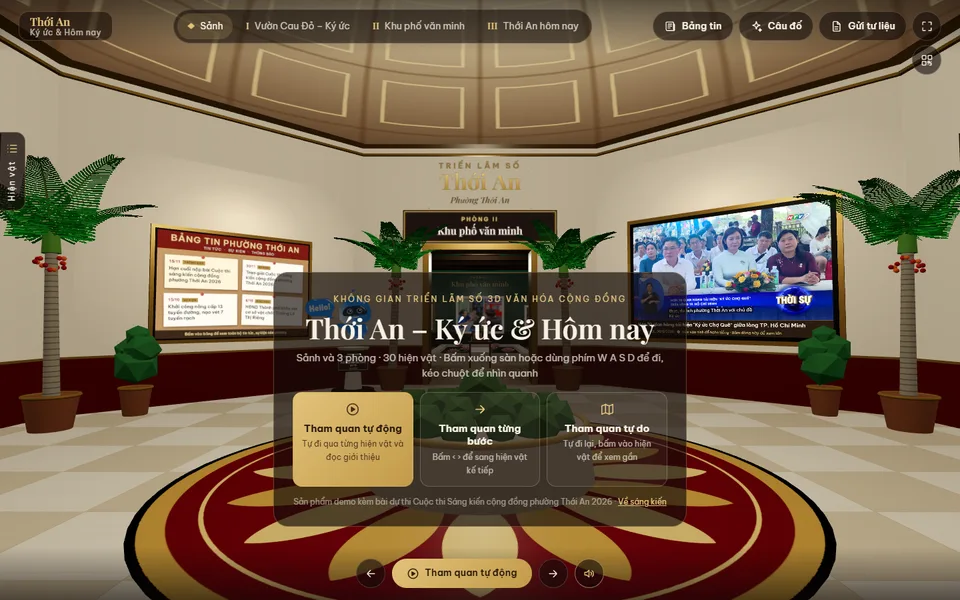 Community initiative
Initiative: Thoi An – Memories & Today
A 3D digital exhibition of a ward’s community culture: a lobby and 3 rooms, 30 narrated exhibits, a ward notice board, a procedure assistant, quizzes and material submissions, plus an initiative summary page.
View demo (opens in a new tab) Research project
Cao Bang tourism research project
A digital product evidencing a research project: 360° tours of tourist sites and landscapes.
View demo (opens in a new tab)
Want to bring your OCOP product story online?
We suggest how to tell it and work with you to build traceability pages with the story and narration, QR stamp sets, product pages, 3D booths and 360° tours of raw material areas. Usually within 3–10 days once the materials are ready.
Related articles
See all articlesVietnam Culture Day, 24 November
What Vietnam Culture Day on 24 November is, why that date was chosen, how many days off there are in 2026, what is organized nationwide, which activities suit schools, communes and wards, and how to choose a cultural model that continues after the day.
ReadDigital transformation initiatives
Digital transformation initiative ideas for kindergartens, primary and secondary schools and communes; how to find ideas, trial them, present results and use a digital product to make the initiative more convincing.
ReadVirtual museums in teaching
What virtual museums and exhibitions are, their types and benefits for teaching history, geography, literature, the arts and STEM; steps to make a 3D virtual museum, free tools, lesson ideas and how to let students create their own exhibitions.
Read